http://store.apple.com/us/browse/home/specialdeals/mac
Sent from my iPhone
Wednesday, July 31, 2013


Fwd: Patterns 101: All you need to know about wearing, mixing, and matching patterns
Sent from my iPhone
Begin forwarded message:
From: "Effortless Gent" <b@effortlessgent.com>
Date: July 31, 2013, 5:14:08 AM PDT
To: imagecandoit@gmail.com
Subject: Patterns 101: All you need to know about wearing, mixing, and matching patterns
Effortless Gent
Patterns 101: All you need to know about wearing, mixing, and matching patterns
July 31, 2013Hey Gents,
Ever get tired of wearing only solid colors? I mean, how interesting can your combinations of gray, white, khaki, and navy really get?
Sure, you may throw in teal, eggplant, or plum once in a while, but still, things tend to get boring fast.
Hence, the importance of pattern! You should include pattern in your everyday outfits. Pattern will add some dimension, texture, and visual interest to whatever you're wearing.
What's that, you say? You're not sure exactly how to incorporate pattern with other items in your closet?
Well, good thing you're here with us today.
We'll go over seven common patterns you may find in stores (maybe even your own closet, right now!), how to distinguish the differences among all of them, and finally, how to incorporate them within your existing wardrobe so you can easily put together a cohesive, good-looking outfit.
Awesome! Let's get started.
(Quick note: I originally outlined this article for The Cladright Association, a new members-only project I'm working on, but I wanted to share it with you today so you can start implementing these ideas now.
If you get a lot of use from this, you should sign up to be notified about Cladright. I'll pass along more information when it's ready.)
Quick Pattern Profiles
Here's a brief overview of seven common patterns you'll see practically everywhere. Keep in mind there may be other patterns out there, but these are the ones you'll encounter a majority of the time.
Pattern #1: STRIPE
Comes in many different scales, from pinstripe (thin) to the wide repp stripe you find in ties.
Really flexible, easily worn with other patterns and of course, goes with all solids.
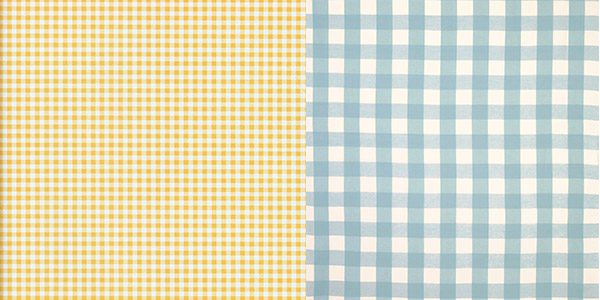
Pattern #2: GINGHAM
Also known as a "check" pattern.
Also comes in many different sizes, from mini to large scale gingham.
Mostly seen in shirts.
Pattern #3: PLAID
You'll find many different styles of plaid (all with different names), but for the sake of this article, let's just lump them all under one title.
Plaid scales vary, but as a whole, plaid prints are typically more busy because of the color plus the actual plaid pattern itself.
Make sure to use plaid sparingly. One plaid item per outfit is usually best.
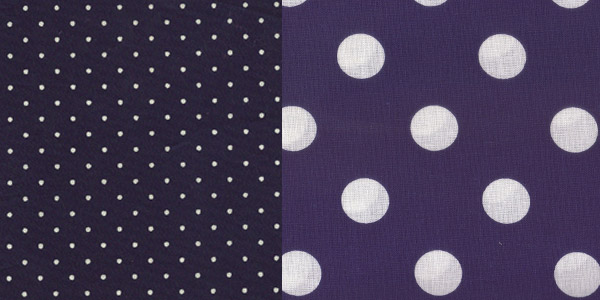
Pattern #4: DOT
Many different scales available, from small pin dot, to very large dots. If you're going for a more refined look, stick with smaller scale dots. Great for shirts and ties.
Dots are fairly flexible as well, and you can achieve different looks depending on the contrast between the garment and the dot pattern. Some dots are close in tone to the shirt (dark shirt, dark dots) while others have high contrast (white dots on dark shirt).
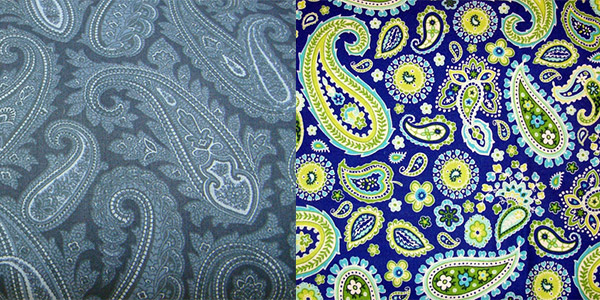
Pattern #5: PAISLEY
Paisley is up there with plaid, as far as the amount of visual attention it commands. Great with ties and shirts.
If wearing a busy pattern such as paisley, make sure to stick to solid colors for the rest of the outfit. If you want to experiment with paisley but are hesitant, find a shirt or tie that is tonal (variations of one color) so you still have that great pattern to work with, but in something that is more subdued.
Pattern #6: HOUNDSTOOTH
Houndstooth is a pattern you'll find everywhere, from shirts and ties to suits (though not necessarily in these colors). There are varying scales of houndstooth, but most are a smaller scale, which adds a nice texture to the garment.
You can wear houndstooth head to toe if you know how to do it right. Stick around and we'll figure out how further down.
Pattern #7: HERRINGBONE
Herringbone is another common pattern you can find in suits, ties, and shirts. The pattern is very common in wool fabrics, and it gets its unique pattern from the way the fabric is woven.
You can find herringbone in varying scales, though in suits and shirts, they are usually tonal and small in scale, which makes it easy to wear with other bold patterns and colors.
There are plenty of patterns out there, but I find these seven to be the most common. If you can master the use of these, those other patterns you come across will be a piece of cake.
How to use pattern in your wardrobe
It's important to start simple. If you try to put together an outfit consisting of several different patterns of varying scales, plus making sure all the colors complement each other, you're sure to be overwhelmed.
Before we get to that, here are some…
Points To Consider
CONSIDER SCALE. Smaller scale patterns are easier to pair with other patterns and bold colors. Larger patterns need to be on their own, otherwise your outfit may look too busy and clash. Not good.
CONSIDER COLOR. Focus on the most prominent color when trying to complement the other colors in your outfit.
LET THE PATTERN BE YOUR MAIN FOCAL POINT. If you're wearing a bold, dotted tie for example, let that be the only attention-grabbing pattern on your body that day. As you advance, you can strategically include other patterns, but tread carefully if you're just learning.
Start Simply = Start With Your Shirt
For now, let the shirt you choose be the base of your outfit. Whatever shirt you decide to wear will be the determining factor of how you incorporate other patterns.
Is your shirt a solid color? Find a tie with the same color "in the background", i.e. the minor color of your tie. For example, if you're wearing a light blue shirt and you want to put on a striped tie, make sure the smallest stripe is similar to that light blue.
This isn't imperative, but I'm using this as an example to illustrate the simplest way to pair your shirt and tie.
Is your shirt patterned? Yes? Okay great.
- Is the shirt pattern small scale? You can wear a bold, patterned tie. This will contrast nicely with the subdued pattern of your shirt. Keep your suit, blazer + trousers, chinos, or denim equally subdued in a neutral or dark tone.
- Is the shirt pattern large scale? Do the opposite to maintain that balance. Choose a small, subtle pattern for your tie, suit, and everything else you're wearing. Let the large scale pattern on your shirt be the boldest item of clothing you have on.
Easy shirt patterns to use as your base
The key here is keeping your scale small, and your color tonal.
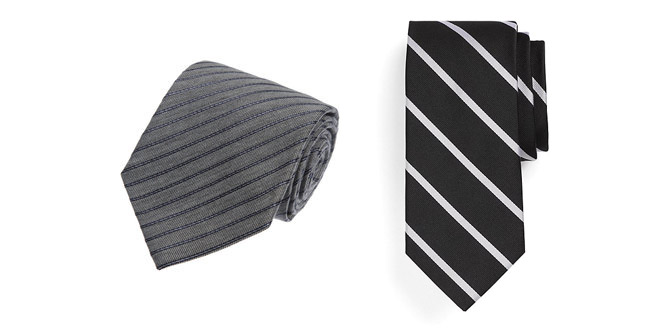
The photo of the ties above is the perfect example of what I mean. You can easily see the difference in contrast between a black and white stripe tie versus a tonal light gray / dark gray tie.
Try squinting a bit, and the tie on the left just looks… gray. The black and white stripes on the right are still clearly visible.
What's the point? When it comes to your shirt, choose something with a small scale pattern that also has a low contrast. From afar, your shirt will look like a solid color, but close up, an observer can see the detail and will think, "Man, this guy knows how to add visual interest to his outfit," or something like that.
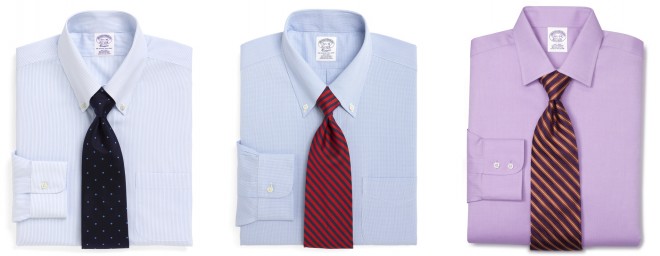
Here are some examples of a mini pinstripe shirt, mini houndstooth shirt, and mini herringbone shirt (click to enlarge and see texture):
Pretty cool, right? These shirts are from Brooks Brothers, by the way (here, here, and here).
The pattern adds a bit of texture to your shirt without being so distracting. On some of these examples, you can barely see the pattern at all. That's great! Treat it like a regular solid shirt when pairing up your accessories. This makes your job a lot easier.
Start Small, Work Your Way Up
There's a rule of thumb I heard somewhere, and the essence of it is to start with smaller patterns closest to your body, and work your way up (in scale, color complexity, and intensity) from there.
First off, it's easy to work multiple patterns together if your base–the clothing closest to your body, (e.g. your shirt), or the "main" item of clothing you're wearing, (e.g. your suit)–is a small scale. From there, you can layer with more interesting and bold patterns and colors.
So for example, your tie can be more bold than your shirt, and then your scarf (if you're a scarf guy) can be a large scale print or design.
Your overcoat can be a standard solid color, or you could do something interesting with another bold print (like Harry Crane, the confused looking fellow in the photo).
See what I'm saying? Small patterns closest to your body, largest and boldest patterns furthest away from your body. Layering. Brilliant!
Pattern + Color: A few more key ideas
Incorporating pattern adds a new level of complexity to constructing an outfit.
Not only do you have to worry about color among your various articles of clothing, you now have to consider the pattern's color as well, not to mention its scale.
Heavens! What's a budding style student to do?
First off, take a breather. It really isn't that difficult once you get the hang of things. If you've made it this far in the article, you've already consumed a good amount of information that will make it easier for you to work in pattern the next time you put clothes on.
As far as harmonizing color with pattern, keep these two things in mind. Let's use the shirt + tie combo as an example:
1.) Take the tie pattern's minor color, and match that with the most prominent color of the shirt. If your shirt is a solid color, that's simple. Feeling a bit more advanced? Don't match the colors exactly; have them complement each other instead. (Here's a bit on complementing color, in case you've forgotten.)
2.) Take the tie pattern's most prominent color, and make sure it matches or complements the boldest color in the rest of your outfit.Regarding #2, see this example. The paisley pattern's color closely resembles the shirt color. The base of the tie (burgundy) meshes well with the blue of the shirt, as well as the warm tones of the sport coat, plus there's a hint of burgundy in that plaid pattern (as well as the scarf that peeks out from underneath).
I guarantee the stylist didn't think too hard about this. After a while, you develop that eye for what works, and it comes naturally. Just keep practicing.
Anyway, these are two different approaches you can take to making sure your outfit looks well put-together. While I never advocate exact matching, making sure colors play nicely together is always important, especially when incorporating patterns that may have multiple colors within it.
One Final Do's and Don'ts List
Do:
- mind pattern scale, especially when pairing with other patterns (remember: start small and work your way up in scale, color complexity, and intensity)
- wear solids (or small scale patterns) as a base for your bolder patterns
- mix small patterns with larger scale patterns
- start small when you first begin experimenting (i.e. a solid suit + patterned shirt, solid dark-colored chinos + dotted shirt, or small scale pattern shirt + bold patterned tie)
- balance bold patterns with more subtle patterns, and vice versa
Don't:
- wear two similarly bold patterns of the same scale in one outfit, as the outfit becomes too busy
- wear two different patterns of the same boldness and scale; those two items will compete with each other visually
- wear different plaids in one outfit; stick to one plaid item, keep everything else solid (see Mr. Murray as an example of what not to do… unless you are Mr. Murray, then you can do whatever the hell you want)
- wear the same exact pattern as a top and bottom (unless it's something like a stripe or check suit).
Finally
Hopefully these tips and pointers help you incorporate pattern into your outfit more often. Doing so adds a bit of dimension and interest to your outfits, much more than solid colors can do on their own.
If there's one main takeaway from this article, it is to start small by adding pattern to ONE piece, keeping everything else a solid color. As you get used to playing with color and pattern, you can experiment with varying scales and layering everything together.
Got a question I didn't answer here? I'd love to hear them in the comments below, so leave em!
–
PS: I hope this was useful to you! If so, you're gonna love Cladright. It's more in-depth content just like this. Remember to get on the notification list, and I'll be sure to let you know once it's ready.
2555 Market St, San Francisco, CA 94114, USA
Unsubscribe | Change Subscriber Options






Fwd: How to Survive a Plane Crash: 10 Tips That Could Save Your Life
Sent from my iPhone
Begin forwarded message:
From: Art of Manliness <artofmanliness@gmail.com>
Date: July 31, 2013, 2:05:11 AM PDT
To: <imagecandoit@gmail.com>
Subject: How to Survive a Plane Crash: 10 Tips That Could Save Your Life
Reply-To: Art of Manliness <artofmanliness@gmail.com>
How to Survive a Plane Crash: 10 Tips That Could Save Your Life
Email not displaying correctly?
View it in your browser.
By Brett & Kate McKay
How to Survive a Plane Crash: 10 Tips That Could Save Your Life
We often think that plane crashes are catastrophic and unsurvivable events. Thanks to movies and 24/7 news channels, the enduring image of a plane crash usually involves an aircraft plummeting to the ground from 30,000 feet and obliterating everyone on board in a terrifying fireball.
Thankfully, that isn't the case. In a report analyzing airline accidents from 1983 to 2000, the National Transportation Safety Board found that the survival rate of crashes was 95.7%. Sure, there are some accidents where everyone, or nearly everyone, died, but those are much rarer than you'd guess based on what you see in the news. The NTSB found that even in serious accidents where fire and substantial damage occurred, 76.6% of passengers still survived.
Combine those stats with the relative rarity of airplane accidents even happening in the first place (the average American's chances of being killed in an airplane crash are about 1 in 11 million), and you can see that flying is actually the safest form of transportation there is. Taking to the road on an average day is far more dangerous — it just doesn't feel like it because you have four (or two) wheels on the ground and a sense of control.
But it's important to take note of another interesting tidbit that the FAA and NTSB found in their research on plane crashes: 40% of fatalities that did occur happened in crashes that were survivable. Close to half of all airplane crash fatalities might have been prevented had passengers taken proper action.
While the odds of being involved in a plane crash may be slim, they're not zero. If it happened to you, would you know what to do to increase your chances of walking away? In today's post we're going to offer research-backed advice from Ben Sherwood's The Survivor's Club on what you can do to make it out of a plane crash alive.
You've Only Got 90 Seconds to Get Out
Understanding this is the key ingredient to surviving, and will frame all the other tips in this post. If you've survived the crash landing, you have a pretty good chance of getting out of the airplane alive. But, you only have 90 seconds to do so.
You see, the thing that kills most passengers in a plane crash isn't the actual impact, it's the fire that typically engulfs the plane afterwards. Folks may be surprised they survived the impact, and become complacent about other dangers. People vastly underestimate how quickly a fire can spread and consume an airplane. Surveys show that most people think they actually have about 30 minutes to get out of a burning plane. The reality is that it takes, on average, just 90 seconds for a fire to burn through the plane's aluminum fuselage and consume everything and everyone in it. If that sounds scary, it should; you need to be motivated to get your rear end out of the plane!
Be Fit
The FAA has rigorously studied and crunched the numbers on airplane crash survivors, as well as tested nearly 2,500 people in simulated evacuations to find out the type of person who typically survives. Their results?
Young, slender men have the best odds of surviving a plane crash. (Old, fat women have the worst odds — sorry Aunt Myrtle.)
The FAA has found that differences in age, gender, and girth account for 31% of the difference between people's evacuation times. Escaping a plane crash requires you to maneuver quickly through narrow aisles with luggage and wreckage strung about. You may even have to throw blockages out of your way. You then have to slip through an emergency exit that may only be twenty inches wide. Kind of hard to do if you're fat and out of shape.
Not only can being out of shape reduce your chances of survival, it could also put other people's lives at risk because they have to wait for you to exit safely. Hold-ups at the exit due to passengers having trouble deplaning has caused many unnecessary deaths. In a runway collision that occurred in 1991, investigators found the charred remains of 10 passengers lined up in the aisle waiting to leave the wing exit; folks who froze up and had trouble squeezing through the exit had created a fatal bottleneck.
If you're on the rotund side, make it a goal to shed some of that table muscle so you'll be fit enough to save your own life and perhaps the lives of others (and not just on a plane, either, but in all kinds of survival situations). We've got plenty of workouts on our site to choose from to get started. If you're looking for more practical and accessible exercise and diet tips, I highly recommend Nerd Fitness.
Fly in Bigger Planes if Possible
If you have the choice between flying in a puddle jumper or a 737, choose the 737. According to FAA investigations, larger planes have more energy absorption in a crash which means you're subjected to less deadly force, and that may equate to a better survival rate. This fact alone is why I try to fly on Southwest — whose fleet consists only of 737s — whenever possible. The carrier is also rated as the third safest in the world (their recent landing gear malfunction notwithstanding). (Landing gear malfunctions aren't actually a big deal, by the way.) Also avoid regional carriers if possible — they have an accidents and incidents rate double that of national carriers and their pilots are often less experienced and overworked. Note that national airlines frequently use a regional carrier for some of the routes that fly under their name.
Remember the Five Row Rule
A few years ago, Popular Mechanics put out an article that analyzed every commercial plane crash in the U.S. and where survivors were sitting in each accident. The article's author concluded that in the event of a crash, the safest place to be sitting was in the back of the plane. After reading that article, I started to sit in the back of airplanes. Come to find out, Popular Mechanics' conclusion isn't well supported by expert research.
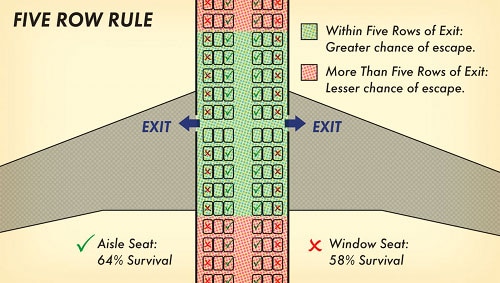
According to the folks who dedicate their lives to studying plane crashes, the statistics are inconclusive because every plane crash is different. Sure, many crashes are nose-first, thus making the back of the plane safer, but several are tail-first (as with the recent incident in San Francisco) or wing-first. You just don't know what kind of crash you'll be in. Instead of worrying about whether your seat is near the back, focus on finding a seat near an exit. According to researcher Ed Galea, those who survive a plane crash typically only have to move an average of five rows to escape. Beyond five rows the chance of getting out alive decreases.
The best seat to have is in the exit row as you'd be the first one out should you need to exit. If you can't snag that seat, go for the aisle. Not only do you have easier access to the lavatory during flight, you also have a 64% chance of survival compared to the 58% chance you'd have sitting in a window seat. Also avoid bulkhead rows. Sure, you have more leg room, but the walls don't "give" as much as seats when you collide with them in a crash.
Galea admits that there are exceptions to the Five Row Rule; he's found people that successfully moved 19 rows to get to an exit. Moreover, even if you're just two rows away from an exit, there's always the chance that the exit door will be blocked or jammed. Overall, though, your chances of survival will increase if you're within five rows of an exit.
Overcome the Normalcy Bias With an Action Plan
As we discussed in detail in our post on why we're hardwired for sheepdom, we're all naturally affected by the Normalcy Bias. The Normalcy Bias causes our brains to assume that things will be predictable and normal all the time. When things aren't normal, it takes our brain a long time to process this. Instead of springing to action when something unexpected happens, our brain kind of shrugs and figures that what is going on can't be so bad, because truly bad events are so out of the ordinary.
Investigators have discovered that Normalcy Bias has caused many unnecessary deaths in plane crashes. Instead of taking immediate action after a crash, people sort of mill around. Many will even start looking for their carry-on luggage before getting to the exit.
Normalcy bias manifested itself in dramatic fashion during a plane collision in 1977 that killed 583 people — the worst aircraft disaster in history. Two 747 jumbo jets collided with each other just above the runway on the small island of Tenerife (part of the Canary Islands off of Morocco). After the collision, one jet tumbled to the ground and exploded, killing all 248 passengers on board.
The other jet crash-landed, but didn't explode. The collision sheared away the top of the jet and flames began to take over the aircraft. Passengers who survived the initial collision could have escaped unharmed, but they had to act fast. Paul Heck, a passenger on the burning plane (who was 65, by the way), sprung to action. He unbuckled his seatbelt, grabbed his wife's hand, and hightailed it to the nearest exit. They, along with 68 other passengers, survived, while 328 died.
In an interview after the disaster, Mr. Heck noted how most people just sat in their seats acting like everything was fine even after colliding with another plane and seeing the cabin fill with smoke. Researchers believe that passengers had a little over a minute to escape before being consumed by the flames, and are convinced that if more people had taken immediate action instead of remaining in their seats pretending like things were okay, the survival rate would have been much, much higher.
To overcome the normalcy bias, you need to have an action plan on what you're going to do in the event of an accident every single time you get on the plane. Know where the exits are. When you've spotted the nearest exit, count the number of rows between yourself and that row. Should it be nighttime, or the interior lights fail, you won't have to succumb to confusion because you'll know right where to go. Size up the passengers around you to see who could be potential roadblocks to your exit. If you're traveling with kids, talk to your wife about who will be responsible for which kid in the event of an accident. Mentally rehearse quickly springing to action as soon as the plane comes to a stop.
Another reason it's important to have an action plan is that there's a good chance you won't have too much assistance from the flight crew. One study found that 45 percent of the flight attendants in survivable crashes are incapacitated in some way. You need to be ready to take action without direction from anyone.
Read the Safety Card and Listen to the Flight Attendants
Another thing you can do to overcome the Normalcy Bias is to read through the safety card as well as listen to the flight attendants when they give their pre-flight safety spiel. Just because you've amassed enough frequent flier miles to circumnavigate the globe 1,000 times, you're definitely not off the hook. You may think you're justifiably confident, but you're probably complacent; in a report published a few years ago, the FAA found that frequent fliers were the least informed on what to do and most susceptible to the normalcy bias in the event of a plane crash.
Re-reading the safety card will remind you where the nearest exits are and what to do during a crash landing. As you read through the safety guidelines, formulate your action plan.
Remember the Plus 3/Minus 8 Rule
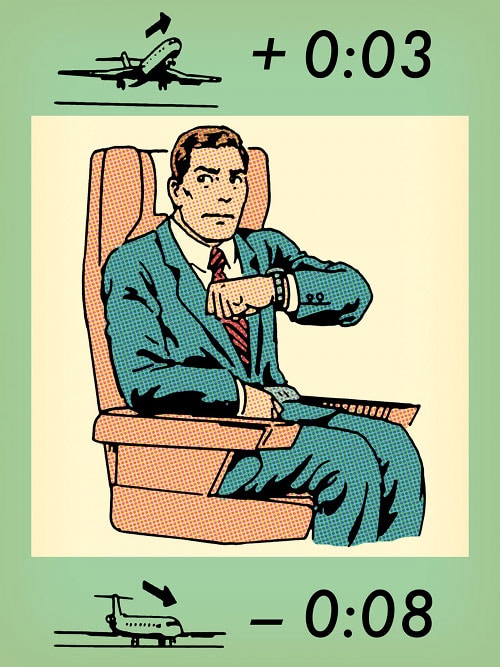
In the aviation world, Plus 3/Minus 8 refers to the first three minutes after takeoff and the last eight minutes before landing. According to flight crash investigators, close to 80% of all plane crashes occur during this timeframe (the events leading up to the recent Asiana plane crash happened during the last 8 minutes of descent). In between those times, the chances of a plane crash occurring drop dramatically. Thus, if you want to up your chances of survival, you need to be extra vigilant and ready to take action during the first 3 minutes after takeoff and the last 8 minutes before landing. Here are some suggestions from The Survivor's Club on what to do and not do during Plus 3/Minus 8:
- Don't sleep.
- Make sure your shoes are on and secured. If you're traveling with your wife or girlfriend, make sure she's wearing flats and not high heels. It's hard to run in stilettos.
- Don't drink before getting on a plane. You want to be fully present in the event of a crash.
- Make sure your seatbelt is securely fastened — low and tight.
- Go over your action plan.
You don't need to be paranoid during this time, just vigilantly relaxed.
Put on Your Oxygen Mask as Soon as It Drops
Airplane cabins are pressurized so you can breathe normally at 30,000 feet. When a cabin loses pressure, there's so little air at high altitudes that getting oxygen to your bloodstream is next to impossible. That's where oxygen masks come in. They pump pure oxygen into your nose and mouth so that you can get the air you need.
In an event where the mask drops from above, put it on as soon as it drops. According to passenger studies, most folks think they can survive an hour without a mask after a plane loses pressure. You actually just have a few seconds. Just a few seconds of oxygen deprivation can cause mental impairment. If you want get out of a crashed airplane alive, you'll want all your mental faculties intact when it lands. Also, follow the safety guidelines of securing your mask first before helping others secure theirs. You're pretty much useless to others if you're not getting oxygen to your brain.
Assume Brace Position
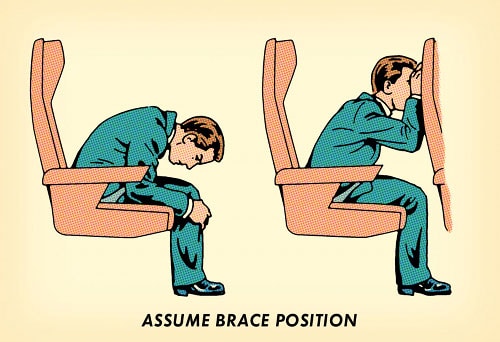
I always thought the brace positions were kind of silly. There's no way that curling up in a ball would help you survive in a plane crash. But research has shown that brace positions do indeed up the chances of survival in an emergency crash landing. The positions help reduce the velocity of your head when it inevitably slams into the seat in front of you. Moreover, they help minimize limb flailing.
Also, make sure your seatbelt is securely fastened — low and tight — over your lap. Those bad boys are designed to withstand 3,000 pounds of force, which is about three times as much as your body could handle without passing out. You can trust 'em.
Forget Your Carry On Luggage, Remember the Kids
Alright. The plane has crash landed and you're still alive. Time to get to those exits as fast as you can. Remember, you only have 90 seconds.
Believe it or not, you need to be reminded to forget your carry-on luggage! It will slow you down and block others' escape, and it may injure you or someone else if you try to get down the very steep inflatable slides with it. You can get another iPad when you return safely to your home.
In your rush to get out of the plane, don't forget your kids. That actually happens. Your brain does stupid things in disasters. Keep reminding yourself, "I have kids. I have kids. I have kids." Ideally, you should have a plan with your wife and kids on who goes with who in case of an emergency exit.
Have any of you been involved in a plane crash? Did you notice normalcy bias take hold of passengers? What do you think helped you escape alive? Share with us in the comments!
______________
Source: The Survivor's Club by Ben Sherwood (Highly recommend picking this up. Crammed with useful information for the sheepdog-in-training.)
Related posts:
- Mayday! Mayday! How to Land a Plane in an Emergency
- How to Jump From a Speeding Car
- How to Jump From Rooftop to Rooftop
- How to Fly Like a Gentleman
- Are You a Sheep or Sheepdog? Part II: 8 Reasons You're Hardwired for Sheepness


Reach 3+ million monthly visitors by advertising on Art of Manliness. Find out how.





Tuesday, July 30, 2013
Fwd: [CORRECTION] YOU'RE INVITED: STREET HEARTS SWIM BASH
Sent from my iPhone
Begin forwarded message:
From: "LA CANVAS" <LA_CANVAS@mail.vresp.com>
Date: July 30, 2013, 9:20:45 PM PDT
To: imagecandoit@gmail.com
Subject: [CORRECTION] YOU'RE INVITED: STREET HEARTS SWIM BASH
Reply-To: "LA CANVAS" <reply-e3c801c47c-32b1509019-5f16@u.cts.vresp.com>


[CORRECTION] YOU'RE INVITED: STREET HEARTS SWIM BASH Correction: The Street Hearts Swim Bash is on SUNDAY, August 4th.
Apologies for any confusion -- we're human too.
See you there!
***
I N V I T E.
Here at LA CANVAS, we're all about girl power. That's why we're excited to celebrate and recognize the achievements of the most anticipated designer platform hitting the trade show scene at PROJECT MVMNT: Street Hearts. In a notoriously patriarchal world, the all-female collective showcases the most progressive brands in contemporary streetwear this season, including womens streetwear pioneers, HELLZ BELLZ/BOTB, accessories maestro Melody Ehsani, and capsule collection goddesses Love+Made.
So put your hangover behind you and join us this Sunday as we celebrate Street Hearts' achievements with drinks, tunes and dancing poolside. After all, a woman's work is never done.
You know what to do:
SUNDAY, AUGUST 4TH, 2013
6250 Hollywood Blvd., Hollywood, CA 90028
12PM - 6PM
Soundtrack by: KITTENS, So Super Sam, and ELLA
Win a Street Hearts package by instagramming your interpretation of your female perspective.
Use the hashtag #streethearts and follow @lacanvas, @whatthehellz, @lovemade and @melodyehsani for a chance to win!
.
Click to view this email in a browser
If you no longer wish to receive these emails, please reply to this message with "Unsubscribe" in the subject line or simply click on the following link: Unsubscribe
LA CANVAS
1778 N. Main St. ( LA CANVAS CLUBHOUSE )
Los Angeles, California 90031
US
Read the VerticalResponse marketing policy.



.jpg "STREET HEARTS INVITE")


Monday, July 29, 2013
Friday, July 26, 2013
Fwd: Latin Words and Phrases Every Man Should Know
Sent from my iPhone
Begin forwarded message:
From: Art of Manliness <artofmanliness@gmail.com>
Date: July 26, 2013, 2:03:28 AM PDT
To: <imagecandoit@gmail.com>
Subject: Latin Words and Phrases Every Man Should Know
Reply-To: Art of Manliness <artofmanliness@gmail.com>
Latin Words and Phrases Every Man Should Know
Email not displaying correctly?
View it in your browser.
By Brett & Kate McKay
Latin Words and Phrases Every Man Should Know
What do great men like Benjamin Franklin, Teddy Roosevelt, and Winston Churchill have in common?
They all were proficient in Latin.
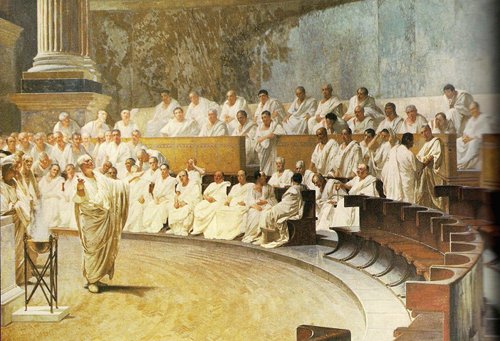
From the Middle Ages until about the middle of the 20th century, Latin was a central part of a man's schooling in the West. Along with logic and rhetoric, grammar (as Latin was then known) was included as part of the Trivium – the foundation of a medieval liberal arts education. From Latin, all scholarship flowed and it was truly the gateway to the life of the mind, as the bulk of scientific, religious, legal, and philosophical literature was written in the language until about the 16th century. To immerse oneself in classical and humanistic studies, Latin was a must.
Grammar schools in Europe and especially England during this time were Latin schools, and the first secondary school established in America by the Puritans was a Latin school as well. But beginning in the 14th century, writers started to use the vernacular in their works, which slowly chipped away at Latin's central importance in education. This trend for English-language learning accelerated in the 19th century; schools shifted from turning out future clergymen to graduating businessmen who would take their place in an industrializing economy. An emphasis on the liberal arts slowly gave way to what was considered a more practical education in reading, writing, and arithmetic.
While Latin had been dying a slow death for hundreds of years, it still had a strong presence in schools until the middle of the 20th century. Beginning in the 1960s, college students demanded that the curriculum be more open, inclusive, and less Euro-centric. Among their suggested changes was eliminating Latin as a required course for all students. To quell student protests, universities began to slowly phase out the Latin requirement, and because colleges stopped requiring Latin, many high schools in America stopped offering Latin classes, too. Around the same time, the Catholic Church revised its liturgy and permitted priests to lead Mass in vernacular languages instead of Latin, thus eliminating one of the public's last ties to the ancient language.
While it's no longer a requirement for a man to know Latin to get ahead in life, it's still a great subject to study. I had to take classes in Latin as part of my "Letters" major at the University of Oklahoma, and I really enjoyed it. Even if you're well out of school yourself, there are a myriad of reasons why you should still consider obtaining at least a rudimentary knowledge of the language:
Knowing Latin can improve your English vocabulary. While English is a Germanic language, Latin has strongly influenced it. Most of our prefixes and some of the roots of common English words derive from Latin. By some estimates, 30% of English words derive from the ancient language. By knowing the meaning of these Latin words, if you chance to come across a word you've never seen before, you can make an educated guess at what it means. In fact, studies have found that high school students who studied Latin scored a mean of 647 on the SAT verbal exam, compared with the national average of 505.
Knowing Latin can improve your foreign language vocabulary. Much of the commonly spoken Romantic languages like Spanish, French, and Italian derived from Vulgar Latin. You'll be surprised by the number of Romantic words that are pretty much the same as their Latin counterparts.
Many legal terms are in Latin. Nolo contendere. Mens rea. Caveat emptor. Do you know what those mean? They're actually common legal terms. While strides have been made to translate legal writing into plain English, you'll still see old Latin phrases thrown into legal contracts every now and then. To be an educated citizen and consumer, you need to know what these terms mean. If you plan on going to law school, I highly recommend boning up on Latin. You'll run into it all the time, particularly when reading older case law.
Knowing Latin can give you more insight to history and literature. Latin was the langua franca of the West for over a thousand years. Consequently, much of our history, science, and great literature was first recorded in Latin. Reading these classics in the original language can give you insights you otherwise may have missed by consuming it in English.
Moreover, modern writers (and by modern I mean beginning in the 17th century) often pepper their work with Latin words and phrases without offering a translation because they (reasonably) expect the reader to be familiar with it. This is true of great books from even just a few decades ago (seems much less common these days – which isn't a hopeful commentary on the direction of the public's literacy I would think). Not having a rudimentary knowledge of Latin will cause you to miss out on fully understanding what the writer meant to convey.
Below we've put together a list of Latin words and phrases to help pique your interest in learning this classical language. This list isn't exhaustive by any stretch of the imagination. We've included some of the most common Latin words and phrases that you still see today, which are helpful to know in boosting your all-around cultural literacy. We've also included some particularly virile sayings, aphorisms, and mottos that can inspire greatness or remind us of important truths. Perhaps you'll find a Latin phrase that you can adopt as your personal motto. Semper Virilis!
Latin Words and Phrases Every Man Should Know
a posteriori from the latter -- knowledge or justification is dependent on experience or empirical evidence a priori from what comes before -- knowledge or justification is independent of experience faber est suae quisque fortunae every man is the artisan of his own fortune --
quote by Appius Claudius Caecus
acta non verba
deeds, not words
ad hoc
to this -- improvised or made up
ad hominem
to the man -- below-the-belt personal attack rather than a reasoned argument
ad honorem
for honor
ad infinitum
to infinity ad nauseam
used to describe an argument that has been taking place to the point of nausea
ad victoriam
to victory -- more commonly translated into "for victory," this was a battle cry of the Romans
alea iacta est
the die has been cast
alias
at another time -- an assumed name or pseudonym
alibi
elsewhere
alma mater
nourishing mother -- used to denote one's college/university
amor patriae
love of one's country
amor vincit omnia
love conquers all
annuit cœptis
He (God) nods at things being begun -- or "he approves our undertakings," motto on the reverse of the Great Seal of the United States and on the back of the United States one-dollar bill
ante bellum
before the war -- commonly used in the Southern United States as antebellum to refer to the period preceding the American Civil War
ante meridiem
before noon -- A.M., used in timekeeping
aqua vitae
water of life -- used to refer to various native distilled beverages, such as whisky (uisge beatha) in Scotland and Ireland, gin in Holland, and brandy (eau de vie) in France arte et marte
by skill and valour
astra inclinant, sed non obligant
the stars incline us, they do not bind us -- refers to the strength of free will over astrological determinism
audemus jura nostra defendere
we dare to defend our rights -- state motto of Alabama audere est facere
to dare is to do
audio
I hear
aurea mediocritas
golden mean -- refers to the ethical goal of reaching a virtuous middle ground between two sinful extremes
auribus teneo lupum
I hold a wolf by the ears -- a common ancient proverb; indicates that one is in a dangerous situation where both holding on and letting go could be deadly; a modern version is, "to have a tiger by the tail"
aut cum scuto aut in scuto
either with shield or on shield -- do or die, "no retreat"; said by Spartan mothers to their sons as they departed for battle aut neca aut necare
either kill or be killed
aut viam inveniam aut faciam
I will either find a way or make one -- said by Hannibal, the great ancient military commander
barba non facit philosophum
a beard doesn't make one a philosopher
bellum omnium contra omnes
war of all against all
bis dat qui cito dat
he gives twice, who gives promptly -- a gift given without hesitation is as good as two gifts
bona fide
good faith
bono malum superate
overcome evil with good
carpe diem
seize the day caveat emptor
let the buyer beware -- the purchaser is responsible for checking whether the goods suit his need circa
around, or approximately
citius altius fortius
faster, higher, stronger -- modern Olympics motto
cogito ergo sum
"I think therefore I am" -- famous quote by Rene Descartes
contemptus mundi/saeculi
scorn for the world/times -- despising the secular world, the monk or philosopher's rejection of a mundane life and worldly values
corpus christi
body of Christ
corruptissima re publica plurimae leges
when the republic is at its most corrupt the laws are most numerous -- said by Tacitus
creatio ex nihilo
creation out of nothing -- a concept about creation, often used in a theological or philosophical context cura te ipsum
take care of your own self -- an exhortation to physicians, or experts in general, to deal with their own problems before addressing those of others
curriculum vitae
the course of one's life -- in business, a lengthened resume
de facto
from the fact -- distinguishing what's supposed to be from what is reality
deo volente
God willing
deus ex machina
God out of a machine -- a term meaning a conflict is resolved in improbable or implausible ways
dictum factum
what is said is done
disce quasi semper victurus vive quasi cras moriturus
learn as if you're always going to live; live as if tomorrow you're going to die
discendo discimus
while teaching we learn
docendo disco, scribendo cogito
I learn by teaching, think by writing
ductus exemplo
leadership by example ducunt volentem fata, nolentem trahunt
the fates lead the willing and drag the unwilling -- attributed to Lucius Annaeus Seneca
dulce bellum inexpertis
war is sweet to the inexperienced dulce et decorum est pro patria mori
it is sweet and fitting to die for your country
dulcius ex asperis
sweeter after difficulties
e pluribus unum
out of many, one -- on the U.S. seal, and was once the country's de facto motto
emeritus
veteran -- retired from office
ergo
therefore
et alii
and others -- abbreviated et al.
et cetera
and the others
et tu, Brute?
last words of Caesar after being murdered by friend Brutus in Shakespeare's "Julius Caesar," used today to convey utter betrayal
ex animo
from the heart -- thus, "sincerely"
ex libris
from the library of -- to mark books from a library
ex nihilo
out of nothing
ex post facto
from a thing done afterward -- said of a law with retroactive effect
fac fortia et patere
do brave deeds and endure
fac simile
make alike -- origin of the word "fax"
flectere si nequeo superos, acheronta movebo
if I cannot move heaven I will raise hell -- Virgil's Aeneid
fortes fortuna adiuvat
fortune favors the bold
fortis in arduis
strong in difficulties
gloria in excelsis Deo
glory to God in the highest
habeas corpus
you should have the body -- a legal term from the 14th century or earlier; commonly used as the general term for a prisoner's legal right to challenge the legality of their detention
habemus papam
we have a pope -- used after a Catholic Church papal election to announce publicly a successful ballot to elect a new pope
historia vitae magistra
history, the teacher of life -- from Cicero; also "history is the mistress of life"
hoc est bellum
this is war
homo unius libri (timeo)
(I fear) a man of one book -- attributed to Thomas Aquinas
honor virtutis praemium
esteem is the reward of virtue hostis humani generis
enemy of the human race -- Cicero defined pirates in Roman law as being enemies of humanity in general
humilitas occidit superbiam
humility conquers pride
igne natura renovatur integra
through fire, nature is reborn whole
ignis aurum probat
fire tests gold -- a phrase referring to the refining of character through difficult circumstances
in absentia
in the absence
in aqua sanitas
in water there is health
in flagrante delicto
in flaming crime -- caught red-handed, or in the act
in memoriam
into the memory -- more commonly "in memory of"
in omnia paratus
ready for anything
in situ
in position -- something that exists in an original or natural state
in toto
in all or entirely
in umbra, igitur, pugnabimus
then we will fight in the shade -- made famous by Spartans in the battle of Thermopylae and by the movie 300
in utero
in the womb
in vitro
in glass -- biological process that occurs in the lab
incepto ne desistam
may I not shrink from my purpose intelligenti pauca
few words suffice for he who understands
invicta
unconquered
invictus maneo
I remain unvanquished
ipso facto
by the fact itself -- something is true by its very nature
labor omnia vincit
hard work conquers all
laborare pugnare parati sumus
to work, (or) to fight; we are ready
labore et honore
by labor and honor
leges sine moribus vanae
laws without morals [are] vain
lex parsimoniae
law of succinctness -- also known as Occam's Razor, the simplest explanation is usually the correct one
lex talionis
the law of retaliation
magna cum laude
with great praise
magna est vis consuetudinis
great is the power of habit
magnum opus
great work -- said of someone's masterpiece
mala fide
in bad faith -- said of an act done with knowledge of its illegality, or with intention to defraud or mislead someone; opposite of bona fide
malum in se
wrong in itself -- a legal term meaning that something is inherently wrong
malum prohibitum
wrong due to being prohibited -- a legal term meaning that something is only wrong because it is against the law
mea culpa
my fault
meliora
better things -- carrying the connotation of "always better"
memento mori
remember that [you will] die -- was whispered by a servant into the ear of a victorious Roman general to check his pride as he paraded through cheering crowds after a victory; a genre of art meant to remind the viewer of the reality of his death memento vivere
remember to live
memores acti prudentes futuri
mindful of what has been done, aware of what will be
modus operandi
method of operating -- abbreviated M.O.
montani semper liberi
mountaineers [are] always free -- state motto of West Virginia
morior invictus
death before defeat
morituri te salutant
those who are about to die salute you -- popularized as a standard salute from gladiators to the emperor, but only recorded once in Roman history
morte magis metuenda senectus
old age should rather be feared than death
mulgere hircum
to milk a male goat -- to attempt the impossible
multa paucis
say much in few words
nanos gigantum humeris insidentes
dwarfs standing on the shoulders of giants -- commonly known by the letters of Isaac Newton: "If I have seen further it is by standing on the shoulders of giants"
nec aspera terrent
they don't terrify the rough ones -- frightened by no difficulties, less literally "difficulties be damned"
nec temere nec timide
neither reckless nor timid
nil volentibus arduum
nothing [is] arduous for the willing
nolo contendere
I do not wish to contend -- that is, "no contest"; a plea that can be entered on behalf of a defendant in a court that states that the accused doesn't admit guilt, but will accept punishment for a crime non ducor, duco
I am not led; I lead
non loqui sed facere
not talk but action
non progredi est regredi
to not go forward is to go backward
non scholae, sed vitae discimus
we learn not for school, but for life -- from Seneca
non sequitur
it does not follow -- in general, a comment which is absurd due to not making sense in its context (rather than due to being inherently nonsensical or internally inconsistent), often used in humor non sum qualis eram
I am not such as I was -- or "I am not the kind of person I once was"
nosce te ipsum
know thyself -- from Cicero
novus ordo seclorum
new order of the ages -- from Virgil; motto on the Great Seal of the United States nulla tenaci invia est via
for the tenacious, no road is impassable
obliti privatorum, publica curate
forget private affairs, take care of public ones -- Roman political saying which reminds that common good should be given priority over private matters for any person having a responsibility in the State
panem et circenses
bread and circuses -- originally described all that was needed for emperors to placate the Roman mob; today used to describe any entertainment used to distract public attention from more important matters
para bellum
prepare for war -- if you want peace, prepare for war—if a country is ready for war, its enemies are less likely to attack parvis imbutus tentabis grandia tutus
when you are steeped in little things, you shall safely attempt great things -- sometimes translated as, "once you have accomplished small things, you may attempt great ones safely"
pater familias
father of the family -- the eldest male in a family
pecunia, si uti scis, ancilla est; si nescis, domina
if you know how to use money, money is your slave; if you don't, money is your master
per angusta ad augusta
through difficulties to greatness
per annum
by the year per capita
by the person per diem
by the day per se
through itself
persona non grata
person not pleasing -- an unwelcome, unwanted or undesirable person
pollice verso
with a turned thumb -- used by Roman crowds to pass judgment on a defeated gladiator
post meridiem
after noon -- P.M., used in timekeeping
post mortem
after death
postscriptum
thing having been written afterward -- in writing, abbreviated P.S.
praemonitus praemunitus
forewarned is forearmed
praesis ut prosis ne ut imperes
lead in order to serve, not in order to rule
primus inter pares
first among equals -- a title of the Roman Emperors
pro bono
for the good -- in business, refers to services rendered at no charge
pro rata
for the rate
quam bene vivas referre (or refert), non quam diu
it is how well you live that matters, not how long -- from Seneca
quasi
as if or as though
qui totum vult totum perdit
he who wants everything loses everything -- attributed to Seneca
quid agis
what's going on? -- what's up, what's happening, etc.
quid pro quo
this for that -- an exchange of value
quidquid Latine dictum sit altum videtur
whatever has been said in Latin seems deep -- or "anything said in Latin sounds profound"; a recent ironic Latin phrase to poke fun at people who seem to use Latin phrases and quotations only to make themselves sound more important or "educated"
quis custodiet ipsos custodes? who will guard the guards themselves? -- commonly associated with Plato quorum
of whom -- the number of members whose presence is required under the rules to make any given meeting constitutional
requiescat in pace let him rest in peace -- abbreviated R.I.P.
rigor mortis
stiffness of death scientia ac labore
knowledge through hard work
scientia ipsa potentia est
knowledge itself is power
semper anticus
always forward semper fidelis
always faithful -- U.S. Marines motto
semper fortis
always brave
semper paratus
always prepared
semper virilis always virile si vales, valeo
when you are strong, I am strong
si vis pacem, para bellum
if you want peace, prepare for war
sic parvis magna
greatness from small beginnings -- motto of Sir Frances Drake
sic semper tyrannis
thus always to tyrants -- attributed to Brutus at the time of Julius Caesar's assassination, and to John Wilkes Booth at the time of Abraham Lincoln's assassination; whether it was actually said at either of these events is disputed
sic vita est
thus is life -- the ancient version of "it is what it is"
sola fide
by faith alone
sola nobilitat virtus
virtue alone ennobles
solvitur ambulando
it is solved by walking
spes bona
good hope
statim (stat)
immediately -- medical shorthand
status quo
the situation in which or current condition
subpoena
under penalty
sum quod eris
I am what you will be -- a gravestone inscription to remind the reader of the inevitability of death summa cum laude
with highest praise
summum bonum
the supreme good
suum cuique
to each his own
tabula rasa
scraped tablet -- "blank slate"; John Locke used the term to describe the human mind at birth, before it had acquired any knowledge
tempora heroica
Heroic Age
tempus edax rerum
time, devourer of all things
tempus fugit
time flees -- commonly mistranslated "time flies"
terra firma
firm ground
terra incognita
unknown land -- used on old maps to show unexplored areas
vae victis
woe to the conquered
vanitas vanitatum omnia vanitas
vanity of vanities; everything [is] vanity -- from the Bible (Ecclesiastes 1)
veni vidi vici
I came, I saw, I conquered -- famously said by Julius Caesar
verbatim
repeat exactly
veritas et aequitas
truth and equity
versus
against veto I forbid vice versa to change or turn around vincit qui patitur
he conquers who endures
vincit qui se vincit
he conquers who conquers himself
vir prudens non contra ventum mingit
[a] wise man does not urinate [up] against the wind
virile agitur
the manly thing is being done
viriliter agite
act in a manly way
viriliter agite estote fortes
quit ye like men, be strong
virtus tentamine gaudet
strength rejoices in the challenge
virtute et armis
by virtue and arms -- or "by manhood and weapons"; state motto of Mississippi
vive memor leti
live remembering death
vivere est vincere
to live is to conquer -- Captain John Smith's personal motto
vivere militare est
to live is to fight
vox populi
voice of the people
What are your favorite Latin phrases? Any other important Latin words and phrases that you think a modern man should know? Share with us in the comments!
Related posts:
- Classical Rhetoric 101: A Brief History
- Three Sheets to the Wind: Nautical Slang in Common Usage
- 30 Days to a Better Man Day 10: Memorize "If"
- Segregating the Sexes
- So You Want My Job: High School Teacher
Reach 3+ million monthly visitors by advertising on Art of Manliness. Find out how.
Follow on Twitter Join us on Facebook Forward to Friend Copyright © 2013 Art of Manliness, LLC, All rights reserved.
You're receiving this email because you opted in at our website artofmanliness.com
Our mailing address is:
The Art of Manliness, LLC
PO Box 978
Tulsa, OK 74037unsubscribe from this list update subscription preferences email template by Joseph Hinson. 


Subscribe to:
Comments (Atom)